Solar, Demystified
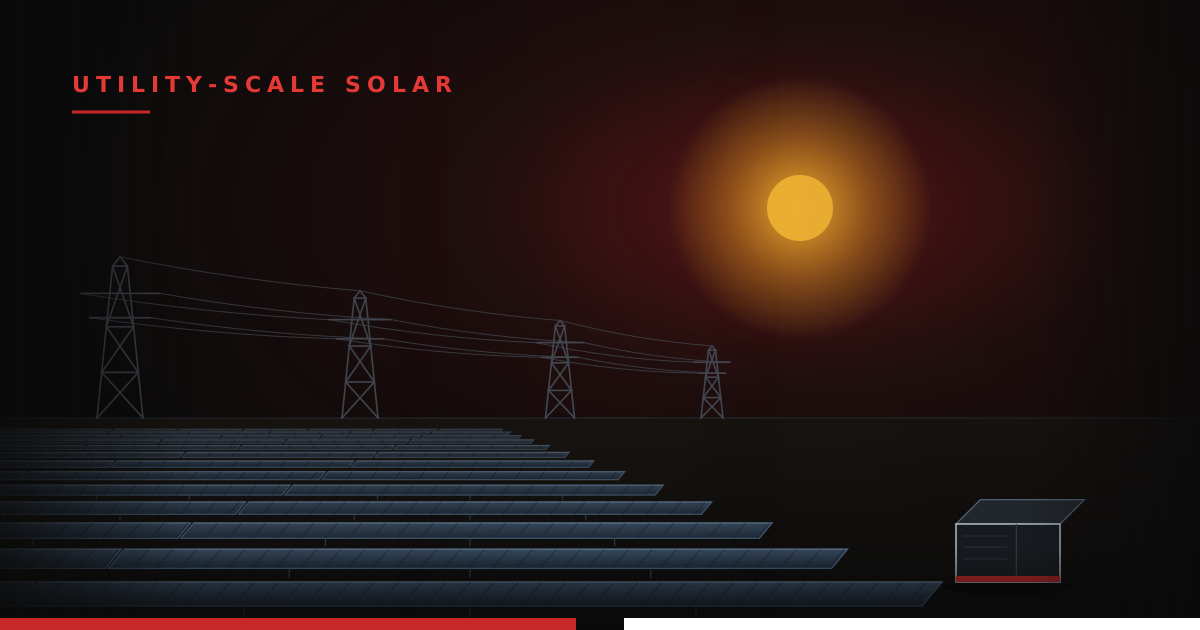
The solar industry wasn't always the powerhouse it is today. For decades it was the stuff of off-grid cabins, RVs, and renewable-energy diehards - a panel or two to keep a battery topped up somewhere the grid did not reach.
Quietly, that has changed. Solar has become the fastest-growing way to generate electricity at utility scale, and it isn't even close. In the US, solar has been the top source of new power for five straight years, and in the first quarter of 2026 alone, solar and battery storage together made up 91% of all new generating capacity added to the grid - with solar itself accounting for 60% (SEIA). It is also the same story internationally. Solar led new capacity additions across the EU in 2025, and that June it became the bloc's single biggest source of electricity for the first time (Ember). China now installs more solar than the rest of the world combined (Ember). Most new power plants going up today, across the US, Europe, and China alike, are solar or solar paired with batteries.
You have probably seen the residential solar version, maybe a few panels on a neighbor's roof. Do not let the size of a utility-scale plant overwhelm you, because underneath it is the same idea. Turning sunlight into electricity is genuinely simple, and it does not get more complicated when you do it a hundred thousand modules at a time; there is just more supporting infrastructure around it.
This post walks through the basics of a solar power plant: what a module is, how it gets mounted, how all that power is collected, and where the industry is heading. It is another post in the Demystified series, feel free to check out the others after you have finished here.
WHY SOLAR, WHY NOW
Three things are driving it.
First, the modules keep getting cheaper and more energy-dense. Panel prices have fallen so far, for so long, that in most regions solar is now the lowest-cost source of new electricity on the grid; each generation of module squeezes more watts out of the same square meter.
Second, batteries have grown up alongside solar and solved its biggest weakness. Storage supplies the offset and the stability a solar-heavy grid needs: it soaks up the midday surplus, pushes it into the evening peak, and holds voltage and frequency steady when clouds roll through. That pairing is what makes it credible to lean hard on solar rather than treat it as a garnish. (We cover the storage side in Battery Storage, Demystified.)
Third, solar breathes new life into otherwise unused land. Build one where the sun shines and you are most of the way there: no fuel to truck in, no cooling water to pipe, no combustion, just open ground and sunlight. That low bar is a big part of why solar spreads so fast. The flat, sunny parcels next to a substation get taken first, and many already are, but solar keeps finding its way onto the harder sites, farther from transmission, cut into odd segments, or laid over rougher terrain. Where most resources need a particular place, solar mostly just needs room.
THE WHOLE PLANT IN ONE PATH
Before we zoom in, here is the entire plant in a single breath, from sunlight to the grid:
Sunlight hits a module, which sits on a foundation and mounting structure. Modules are wired in series into strings; strings are gathered onto DC homerun cables that run to an power conversion station - a large inverter paired with a medium-voltage step-up transformer. Those stations tie together into MV feeders that home-run to a substation, which steps the voltage up again and hands the power to the grid.
That is the whole journey, one that will be walked through in more detail in this post. The substation and the grid connection are their own deep topic; rather than repeat it here, see The One-Line Diagram, Explained, which maps the electrical plant end to end.
WHAT A MODULE ACTUALLY IS
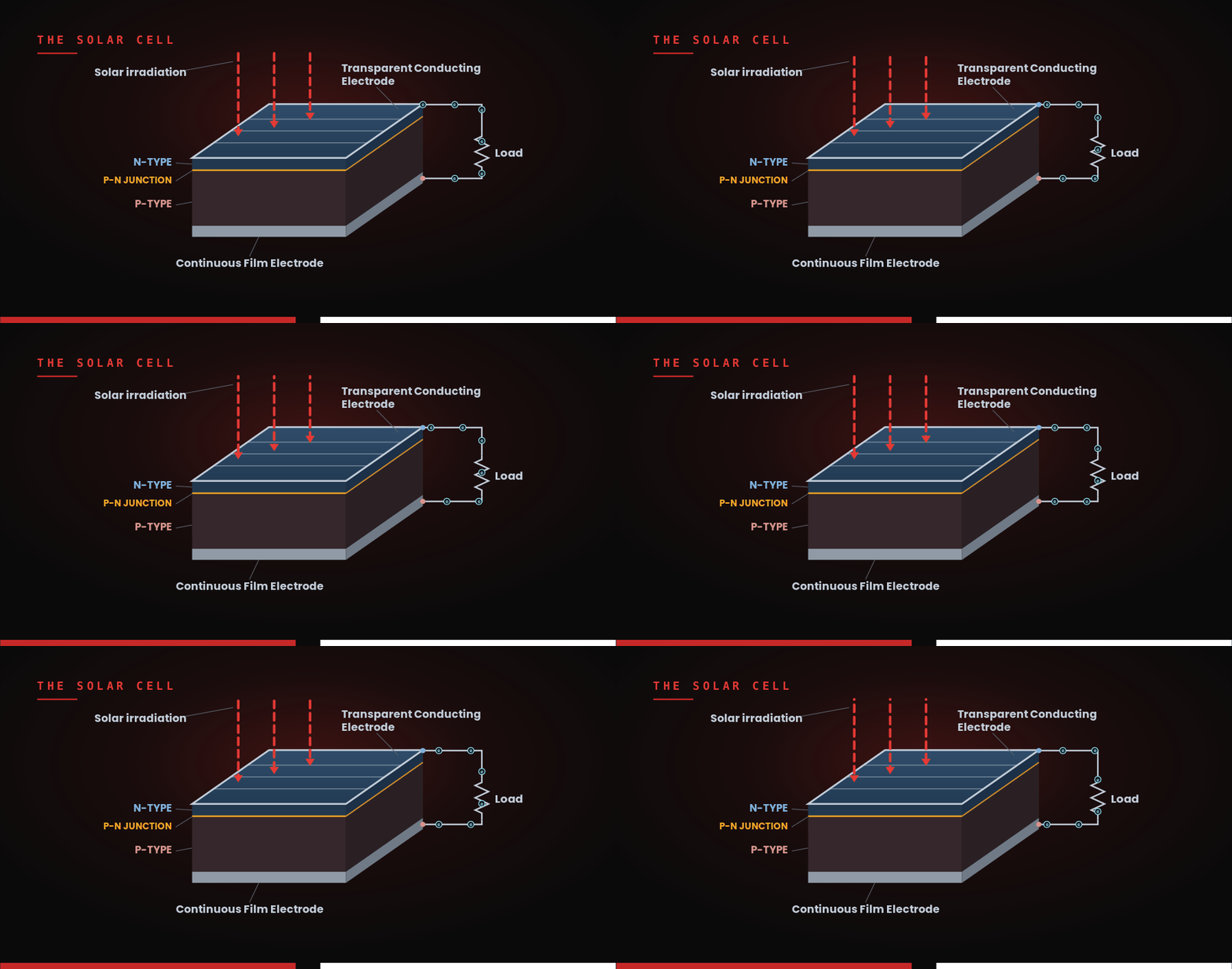
A solar module is made up of many solar cells wired together behind a sheet of glass. The cell is where sunlight becomes electricity, and the cleanest way to picture it is to run a familiar device backward.
An LED is at its core a diode: push current through it and it emits light. A solar cell is the same kind of device operated in reverse: shine light on it and it produces current. Both are built on a semiconductor p-n junction, a boundary between two slightly different layers of silicon. When a photon lands on that junction it knocks an electron loose, and the junction's built-in field sweeps it off in one direction; do that across billions of photons and you have a usable current. That is the entire photovoltaic effect: a reversed light-emitting diode.
A few distinctions come up constantly and are worth having straight:
- N-type is displacing p-type. "Doping" means adding a trace of another element to silicon to give it spare charge carriers. Phosphorus leaves extra free electrons, a negative (N-type) layer; boron leaves "holes," missing electrons that behave like positive charges, a positive (P-type) layer. Every cell joins the two at a junction; the label just says which one forms the thick base wafer the cell is built on. Boron P-type (the PERC cell) was the workhorse for decades, but the boron brings defects that make it degrade a little faster and sag more in heat. Phosphorus N-type (TOPCon most prominently) sidesteps them, so it holds output better and lasts longer; it costs more to build, and the industry is moving to it anyway.
- Mono won; poly is gone. Monocrystalline cells, cut from a single silicon crystal, so thoroughly out-perform the older polycrystalline (multi-crystal) cells that poly has all but vanished from utility-scale supply. If someone still says "poly," they are describing the past.
- Bifacial is standard on big projects. Modern utility modules are glass on both faces and generate from the back as well as the front, harvesting sunlight that reflects off the ground (the albedo). Paired with trackers, that back-side gain is real energy, not a rounding error (~20% gain).
Not every module is silicon. A large and growing share of US utility-scale supply is thin-film cadmium telluride (CdTe). Instead of slicing crystalline wafers, a thin layer of semiconductor is deposited directly onto glass. CdTe holds its output better in high heat, partial shading, and humidity - part of why it competes so well in hot US climates. The manufacturing scale, and US tariffs, have made these panels a common sight on large American projects. On a US site today, there is a real chance the modules are CdTe rather than crystalline silicon.
Whatever the chemistry, every module is built to live outdoors for decades: rated to shrug off UV, rain, snow, wind, and hail, and warrantied to still make most of its rated power after twenty-five years or more.
MOUNTING: TRACKERS VS FIXED TILT
Before the mounting structure comes the foundation, which on most sites is a steel pile driven straight into the ground - simple, fast, and cheap where the soil cooperates. Where it does not, the answer is ground screws, helical piles, or ballasted concrete. Whether a plain driven pile will hold is a soils question, which is one reason geotechnical testing is crucial.
On top of the foundation sits one of two mounting structures, and the choice shapes the economics of the whole plant.
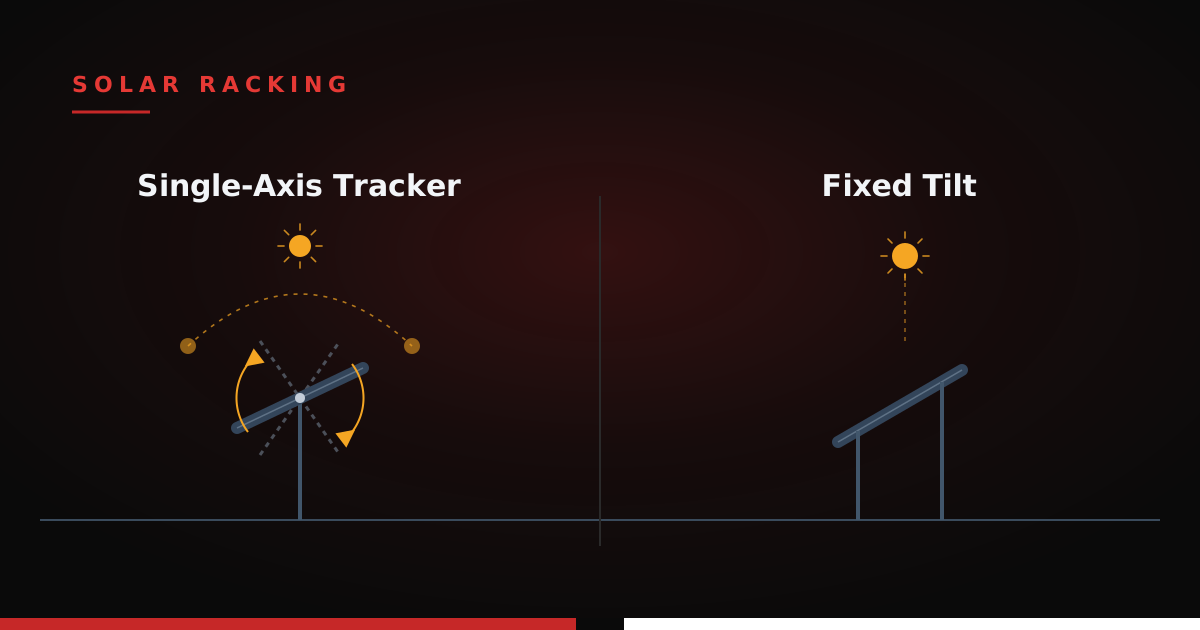
The single-axis tracker (SAT) is the utility-scale default. Rows of modules ride on a north-south steel torque tube that slowly rotates east to west through the day, following the sun so the panels face it as squarely as possible from morning to evening. That motion needs a little power, supplied one of three ways: a small dedicated "pony panel" on the tracker itself, a parasitic tap off the nearest string, or a dedicated supply run out to the row. Trackers cost more to install and add moving parts to maintain, but they buy a meaningful bump in annual energy per module.
Trackers also do something clever near sunrise and sunset called backtracking: instead of aiming straight at a low sun, where adjacent rows would shade each other, the trackers deliberately rotate back, trading a little direct aim to keep neighboring rows out of each other's shadows. How tightly the rows are packed in the first place is its own design lever, the ground coverage ratio, which we break down in GCR Basics.
Fixed tilt is the simpler alternative: modules bolted to a stationary rack, permanently facing south at a set angle (occasionally split, half the site facing east and half west). There are no motors, no controllers, and far less to maintain, so the install is cheaper - but a fixed panel only sees the sun head-on for part of the day, so it makes less energy over the year than a tracker on the same ground.
GATHERING THE DC
Every module puts out direct current, and before it can go anywhere it has to be collected from thousands of panels scattered across the site. That is the DC collection system, and it is more of an engineering problem than it first looks.
It starts with the string. Rather than wire every module home individually, modules are connected in series so a run of them shares one pair of conductors, which cuts the amount of copper dramatically. Exactly how many modules belong in a string is a real calculation with a cold-weather ceiling and a hot-weather floor; we walk through it in Calculating String Size. Those string cables are relatively small and run right along the torque tube, snapping into standardized connectors (MC4 is the common one).
Strings then terminate one of two ways: onto a trunk bus that daisy-chains rows together, or into a DC combiner box that ties many strings onto one larger output. A trunk-bus arrangement ends at a load-break disconnect so a section can be safely opened. Either way, the collected power leaves on a larger DC homerun cable bound for the inverter.
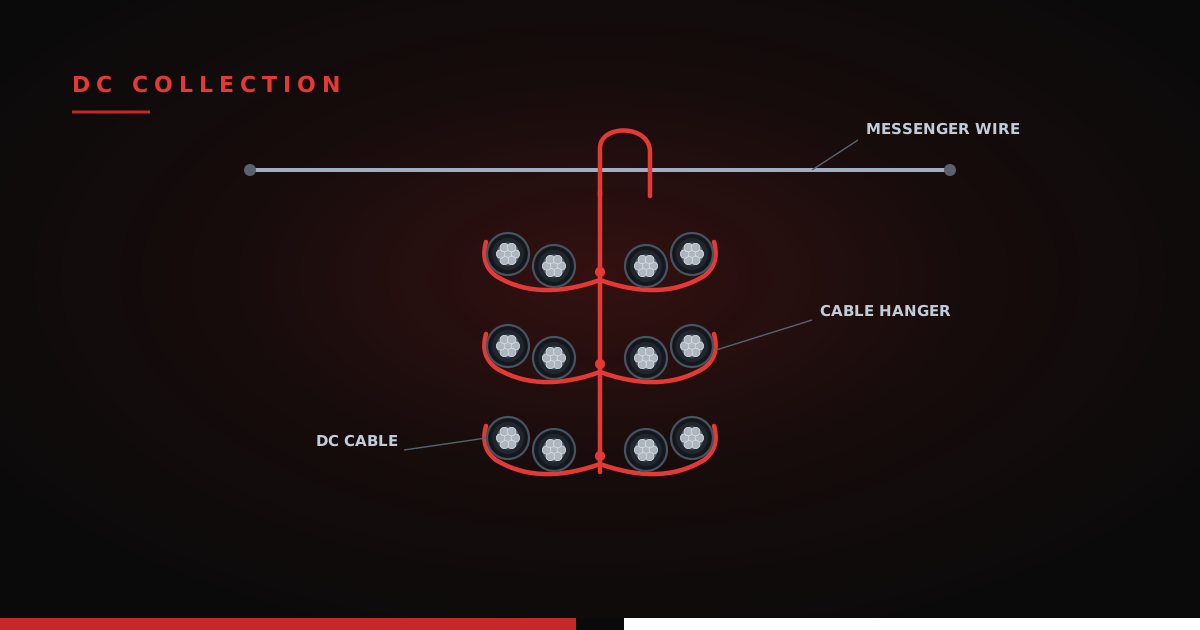
Most of this cable is run above ground, clipped to a steel messenger wire strung between supports with hangers, rather than buried. That is deliberate. A cable hanging in open air sheds heat far better than one packed in soil, so it earns a higher "free-air" ampacity rating and can carry more current for its size. It also makes the cable easy to inspect and repair. The flip side is that the cable management system - the messenger, hangers, and routing - is a first-class part of the design, not an afterthought. Get it wrong and you are chasing sagging, chafing conductors across a live plant for the next thirty years.
THE INVERTER
At the end of every DC homerun is the one component that does the real conversion: the inverter, which turns the plant's direct current into grid-synchronized alternating current.
Its first job is to find the sweet spot. A solar array's best operating voltage drifts constantly with sunlight and temperature, so the inverter runs maximum power point tracking (MPPT), continuously nudging its operating point to pull the most power the array can give at that instant. That MPPT voltage window is exactly what bounds the string-sizing math linked above.
There is a long-running split in how inverters are deployed. In the US, utility-scale plants overwhelmingly use large central inverters: big, single units, each handling a whole block of the array. Much of the rest of the world leans toward string inverters, many smaller units distributed across the field. Each approach trades off cost, redundancy, and maintenance differently; the US has simply settled on central for now.
One more concept ties the whole plant together: the DC-to-AC ratio. Plants are deliberately built with more DC panel capacity than the inverter can output - often 1.1 to 1.2 or higher. On a brilliant midday the array would produce more than the inverter's AC rating, so the inverter clips the excess, holding its output flat at the ceiling. That sounds wasteful, but overbuilding the cheap DC side allows for longer periods of full power generation, and keeping the expensive inverter and grid connection busy for more hours of the day is usually the better economic trade. It is the same "energy versus power" tension we unpack in Energy vs Power.
PUTTING A NUMBER ON THE ENERGY
Every choice in this walkthrough - module type, fixed tilt or tracker, row spacing, string length, the DC-to-AC ratio - changes how much energy the plant actually makes in a year. Rolling all of it into a single number is the job of an energy model, and one tool has been the de facto standard for years: PVsyst. Feed it the site location and irradiance data, the module and inverter datasheets, the layout, and the loss assumptions (soiling, shading, wiring, temperature, degradation), and it simulates the plant hour by hour to predict annual output. It runs on everything from a single rooftop to a gigawatt-scale plant, and its yield estimates, the P50 and P90 numbers, are what lenders underwrite against, which is why nearly every project passes through it before a shovel hits the ground.
WHERE IT IS HEADED
The plant of the next decade is taking shape along a few clear lines.
The cells keep getting denser and cheaper, and the technology to watch is the perovskite tandem: a thin perovskite layer stacked on top of a silicon cell to capture light the silicon wastes, pushing efficiencies past what either could reach alone. It is not mainstream yet, but it is the most likely next step change.
Fixed tilt may also be making a comeback. Trackers win when modules are expensive, because it is worth spending on motors to wring more energy from each pricey panel. As module prices keep falling, at some point it becomes cheaper to just add more cheap fixed panels than to pay for the tracking hardware - flipping a calculation the industry has taken for granted.
The electrical backbone is scaling up. Systems are climbing from 1500 V to 2000 V (2 kV) on the DC side, and the collection gear is growing to match, with DC combiners and load-break disconnects moving from 400 A to 600 A ratings. Both trends push more power through the same hardware, cutting the count of conductors, combiners, and disconnects a plant has to buy and maintain. It is the string-sizing logic again, one level up.
The field itself is getting smarter. Terrain-following trackers flex to rolling ground that used to be graded flat, opening up sites that were once too rough to use. Robotic crews are starting to drive piles, lift and place modules, and handle inspection and cleaning, taking on work that is punishing at plant scale. And everything runs better on better information: smarter plant controls and higher-resolution irradiance data let operators forecast and dispatch output more precisely.
Finally, solar is broadening who gets to own a piece of it. Community solar lets people who rent, live in condos, or cannot finance a rooftop system subscribe to a share of a larger local array and see the credit on their bill - opening a resource that used to belong mostly to homeowners with the right roof and the right budget.