GCR Basics

If you've spent any time around ground-mount solar, you've seen "GCR" thrown around in layout reviews and yield reports — usually right before someone starts arguing about how many megawatts fit on a parcel. It sounds like jargon, but the idea behind it is simple, and it sits at the center of nearly every trade-off in solar plant design. Here's what it means and why it drives so many decisions.
WHAT GCR ACTUALLY MEASURES
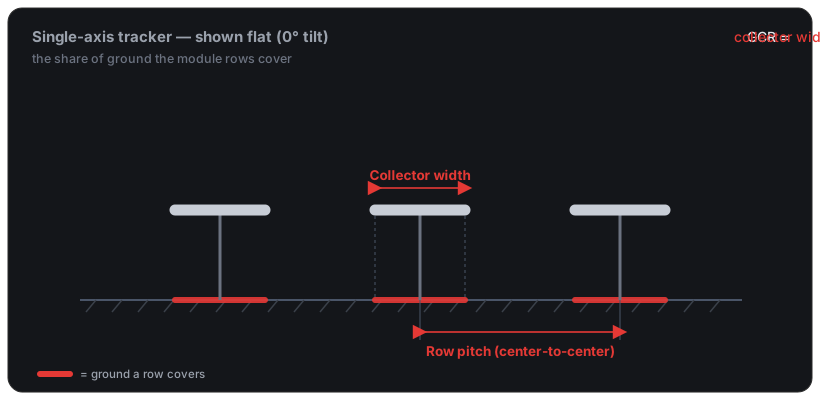
GCR — ground coverage ratio — is just how much of the ground your solar panels cover. Take the width of a row of modules and divide it by the distance from the center of one row to the center of the next (the "row pitch"):
GCR = collector width ÷ row pitch
Pack the rows close together and GCR is high; spread them out and it's low. That's the whole definition. It's a ratio, so you'll see it written either as a decimal (0.40) or a percentage (40%). Utility-scale single-axis trackers typically land somewhere around 0.25 to 0.40; fixed-tilt arrays often run a bit higher.
The intuition is beach umbrellas on a crowded shoreline. Cram them together and you fit more people — but they start throwing shade on each other. Spread them out and everyone gets full sun, but you need a much bigger beach. GCR is exactly that dial, for solar.
A QUICK EXAMPLE
Say each tracker row is a single module in portrait — about 2 meters of module width, a common single-axis tracker setup. Space the rows 8 meters apart, center to center, and your GCR is 2 ÷ 8 = 0.25. Tighten that spacing to 6 meters and it climbs to 2 ÷ 6 ≈ 0.33.
That difference sounds small, but it isn't. Going from 8-meter to 6-meter pitch lets you fit about 33% more rows on the same land — 33% more modules, and 33% more nameplate capacity per acre. The catch: those tighter rows shade each other more in the early morning and late afternoon, when the sun sits low, so each module gives up a little production over the year.
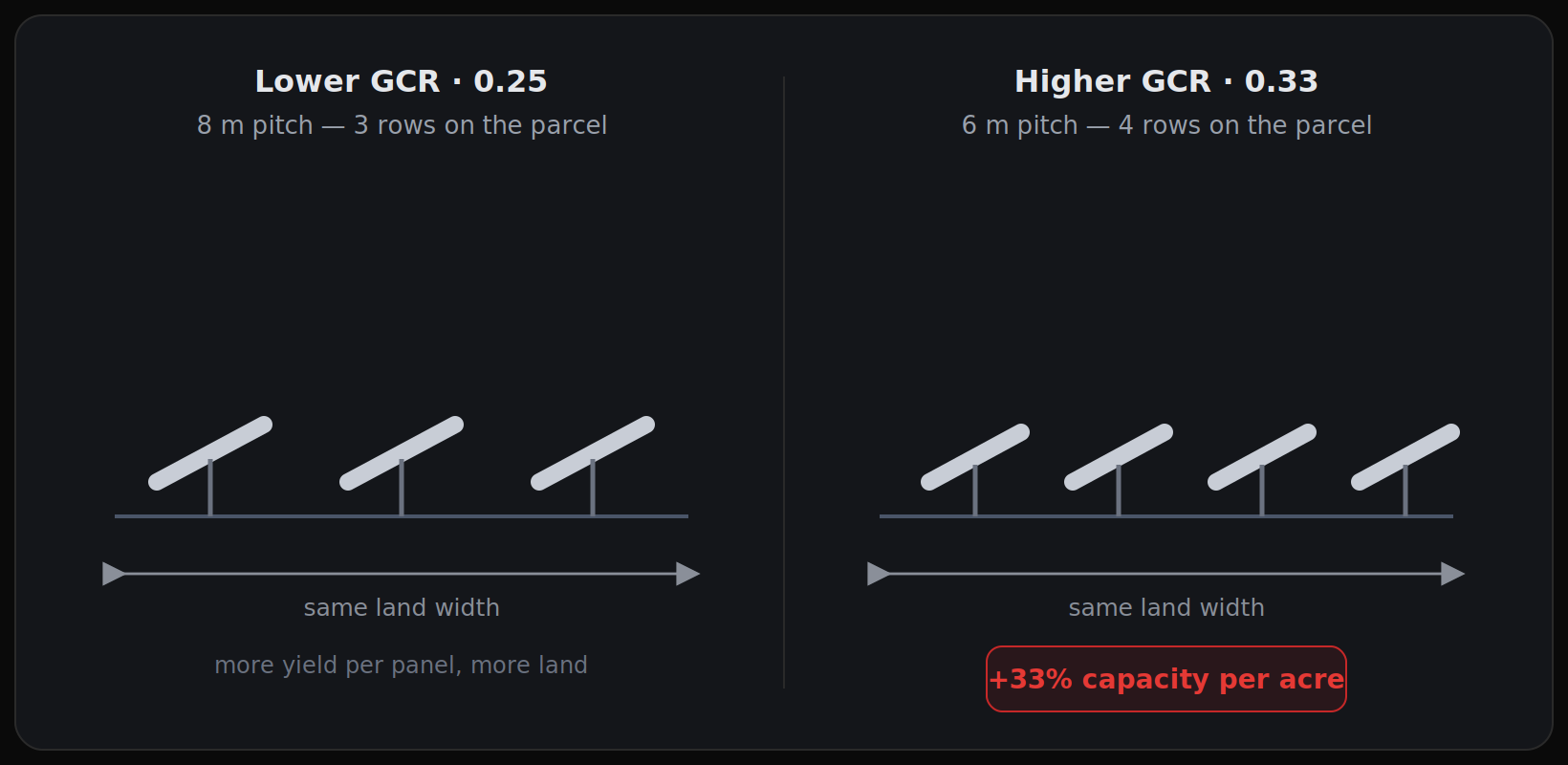
So the denser layout buys more capacity per acre but slightly lower output per panel. Which one wins?
WHY IT MATTERS
That question — capacity per acre versus output per panel — is the heart of it. GCR is where two competing costs meet.
Push GCR up and you spread your fixed costs (land, roads, fencing, cabling) across more megawatts. Land and civil work get cheaper per watt, and the plant is more compact. But mutual shading rises, specific yield (the energy you get per kilowatt installed) drops, and trackers have to "backtrack" more aggressively to dodge each other's shadows, leaving some energy on the table. There's a durability angle too: when shading falls on the same cells day after day, it can create hot spots that stress those cells and shorten a module's life.
Push GCR down and every row sees more open sky. Yield climbs and shading losses shrink — but now you're paying for more land and stringing cable across a bigger footprint.
There's no universal right answer, because the best spacing depends on the site:
- Land cost. Cheap, plentiful land favors spreading out; expensive or constrained land pushes you denser.
- The value of energy. A high-priced power contract rewards squeezing out every last kilowatt-hour (lower GCR); a low one rewards raw capacity (higher GCR).
- Fixed-tilt vs. tracker — and latitude. On fixed-tilt arrays, latitude matters a lot: the farther from the equator, the lower the winter sun sits and the worse close-packed shading gets, pushing you toward wider spacing and a lower GCR. Single-axis trackers largely sidestep this — backtracking rotates the panels to avoid shading their neighbors, so latitude has far less say in the optimal GCR.
Design tools sweep GCR across a range, model the annual energy at each step, and pair that with the cost side to find the layout with the best economics — usually the lowest levelized cost of energy (LCOE), not the most megawatts. That's the part newcomers tend to miss: the goal generally isn't to cram in as much capacity as the land will hold. It's to find the spacing where the next bit of added capacity stops being worth the yield you give up to get it.
KEY TAKEAWAYS
- GCR = collector width ÷ row pitch — how tightly your rows are packed, written as a decimal or a percentage.
- Higher GCR means more capacity per acre and lower land and balance-of-system cost per watt, but more shading and lower output per panel.
- Lower GCR means better yield and less shading, but more land and a bigger footprint to build and wire.
- The optimum is site-specific, driven by land cost, the value of the energy, and the racking type — fixed-tilt (where latitude matters a lot) versus single-axis tracking (where backtracking makes latitude far less decisive).
- The target is usually best economics (LCOE), not maximum megawatts — the sweet spot is where extra capacity stops paying for the yield it costs you.