Energy vs Power: And Why it Matters in BESS Design
Few mix-ups cause more confusion in energy conversations than kW versus kWh. They're one letter apart, they sound interchangeable, and they get swapped constantly — in meetings, on spec sheets, in news headlines. But they measure two completely different things, and for battery storage the distinction is everything. Get it straight, and the rest of BESS design starts to make sense.
POWER VS. ENERGY
Here's the whole idea in one line: a kilowatt (kW) is a rate; a kilowatt-hour (kWh) is an amount.
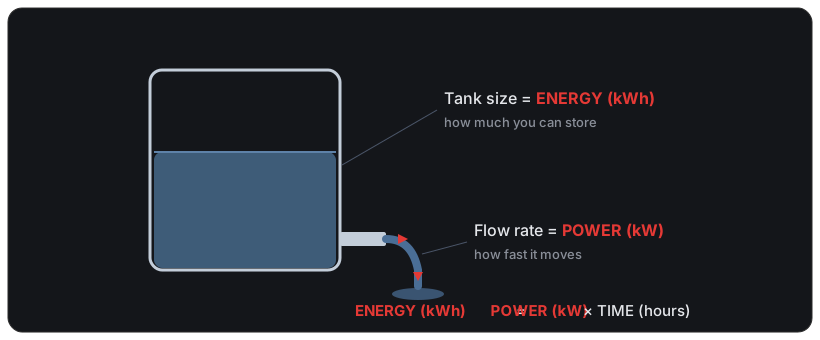
Power (kW) is how fast energy moves — the rate of flow at any instant. Energy (kWh) is how much moves over time; it's power multiplied by duration. One kilowatt flowing for one hour delivers one kilowatt-hour. Run 2 kW for 3 hours and you've moved 6 kWh.
The cleanest way to feel the difference is a water tank. The size of the tank is your energy — how much water you can hold (kWh). The width of the spigot is your power — how fast that water can pour out (kW). A big tank with a narrow spigot holds a lot but only trickles; a small tank with a wide spigot empties fast but doesn't last. The two are independent: knowing one tells you nothing about the other.
A QUICK EXAMPLE
Batteries have exactly these two independent ratings, and you size both. Say you want a battery to cover an evening peak — deliver 50 MW for 4 hours. The power rating is set by how hard you need to push: 50 MW. The energy rating is power × time: 50 MW × 4 h = 200 MWh. So you'd spec a 50 MW / 200 MWh system.
Two shorthand numbers fall out of that pair:
- Duration = energy ÷ power = 200 ÷ 50 = 4 hours (how long it runs at full power).
- C-rate = power ÷ energy = 50 ÷ 200 = 0.25C (the inverse of duration — how fast it cycles relative to its size).
Now change only the job. If you needed that same 50 MW for just one hour — say, fast grid support — the energy drops to 50 MW × 1 h = 50 MWh: a 50 MW / 50 MWh, one-hour, 1C system. Same power, a quarter of the energy, and a very different (and cheaper) battery. That's the whole point: power and energy move independently, and the use case sets the ratio.
WHY IT MATTERS FOR BESS
Because the two ratings are independent, they drive nearly everything downstream:
- Procurement and cost. A battery is quoted as power and energy (MW and MWh, or MW and hours). The power side is largely the inverters and power-conversion system; the energy side is the cells. They scale and price differently — so "a 50 MW battery" is only half a spec. Fifty megawatts for how long?
- Use case sets the shape. Fast, frequent jobs like frequency regulation want high power and little energy — short duration, high C-rate. Energy jobs like solar shifting or replacing a peaker plant want long duration, four hours and up.
- Warranties and augmentation. Cell degradation and throughput guarantees are written against energy (kWh) and cycles, not power — so the energy rating is what you track over the life of the plant.
- Real vs. nameplate. Usable energy always lands a bit below the nameplate kWh once you account for depth-of-discharge limits and round-trip efficiency — worth remembering when you size to a target.
Keep kW and kWh straight and BESS stops being a black box: you can read a spec, sanity-check a proposal, and understand why two "50 MW" batteries can cost wildly different amounts.
KEY TAKEAWAYS
- kW is power (a rate); kWh is energy (an amount). Power is how fast; energy is how much. kWh = kW × hours.
- Batteries carry both ratings, set independently. You size the power (MW) and the energy (MWh) separately.
- Duration = energy ÷ power; C-rate = power ÷ energy. A 100 MW / 400 MWh battery is a 4-hour, 0.25C system.
- The use case sets the ratio. Fast response wants high power and low energy; energy shifting wants long duration.
- "A 50 MW battery" is half a spec — always ask: for how long (how many MWh, or how many hours)?