SCADA, Demystified
A utility-scale solar or energy storage plant is hundreds of acres and contains thousands of devices; yet on a normal day there is nobody on site. Don't let the apparent lack of action fool you; under the calm is a busy hum of networking: every breaker is being watched, every inverter and battery is reporting in, and when the grid operator calls for less power at 2 p.m. or a fast dose of reactive power, the plant answers within seconds. The workhorse system that makes an unmanned power plant possible is SCADA.
SCADA stands for Supervisory Control And Data Acquisition, and the two jobs are right there in the name: acquire the data (watch everything) and supervise the control (command it). It is how the plant is operated day to day, how equipment failures get caught before they become outages, and how the plant keeps the promises written into its interconnection agreement.
This post breaks down what a SCADA system is made of: a tour of the plant controls, the network equipment that carries them, and the standards the system has to follow.
THE TWO JOBS: WATCH AND COMMAND
Start with data acquisition, the eyes of the plant. SCADA continuously pulls status from everything that matters: inverter and PCS status, AC and DC power, feeder and revenue metering (MW, MVAR, voltage, frequency), the open or closed position of every breaker and switch, whether each device is in or out of service, and a constant stream of alarms and faults. On the solar side it also watches tracker positions and the MET (meteorological) station (irradiance, temperature, wind). On the battery side it watches state-of-charge, state-of-health, rack and cell temperatures, and the battery management system's own alarms.
Then there is supervisory control, the hands of the plant. Through the same system an operator (or an automatic controller sitting on top of it) can ramp the plant up or down, curtail output, set a voltage or power-factor target, and open or close breakers to bring equipment in and out of service. A battery adds one command the others do not have: charge, to pull power in from the grid.
Underneath all of this is the points list, the master I/O list naming every value the system reads or writes, tagged as analog (a measured number like 34.7 MW) or digital (a yes/no like breaker-closed). The points list is the registry of every known address; if a signal is not on it, SCADA cannot see or touch it.
THE ARCHITECTURE: FIELD TO CENTRAL
The hardware is organized in layers, and understanding the layers makes the whole system legible.
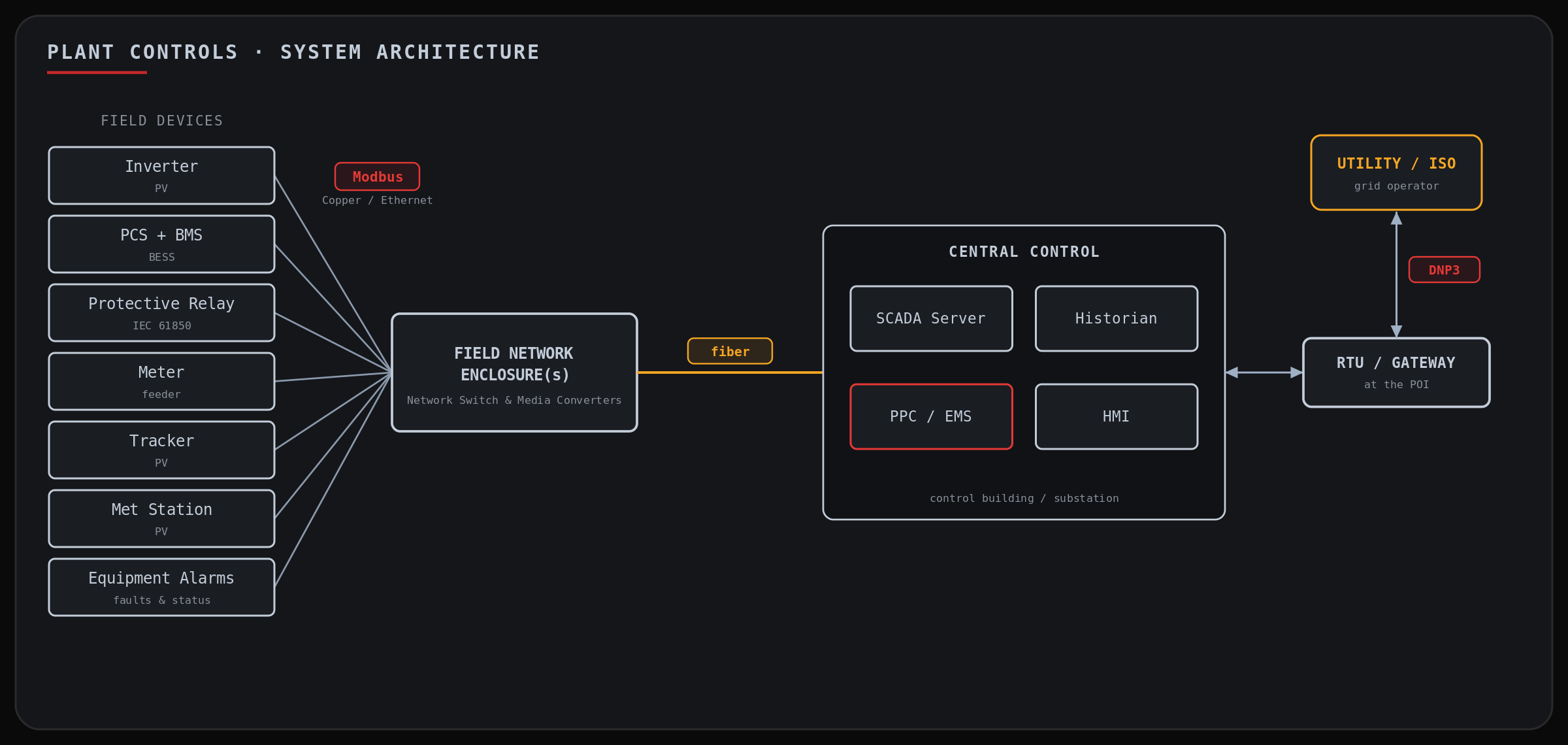
At the bottom are the field devices: inverters, the PCS and BMS on a battery, protective relays, revenue and feeder meters, trackers, and weather stations. Each one speaks a communication protocol and carries a unique IP address, exactly like devices on any office network.
Those devices are gathered by field network enclosures, the comms cabinets (sometimes called data collectors, or built around a small RTU or PLC) distributed across the site near each inverter block or battery cluster. Local equipment lands there over short copper and ethernet runs; the enclosure handles any necessary media conversion and sends the data back on a single fiber home-run to a central location. Fiber does the long hauls because a plant can be miles across, and it carries data over that distance with far lower loss than copper.
At the top is the central network equipment, usually in a control building or the substation control house: the switches, the SCADA server, and the historian - integrating every device on site by IP into one coherent picture. This is the same regardless of whether the plant makes power from panels, batteries, or both.
THE BRAIN: THE PPC (AND, FOR BATTERIES, THE EMS)
Here is the distinction that trips up almost everyone: SCADA is the nervous system, not the brain. It senses, it actuates, and it carries the messages, but the decisions are made by controllers sitting on top of it.
The brain on every plant is the Power Plant Controller (PPC). It takes the grid operator's setpoints and turns them into coordinated commands across all the inverters or PCS units at once: active-power limits and ramp rates, reactive power / voltage / power-factor regulation, frequency response, and ride-through. This is the box that actually delivers what the interconnection agreement demands, and it is the same idea for solar and for storage. SCADA does not replace the PPC; it gives operators visibility into what the PPC is orchestrating and the ability to supervise it. (If you have read the plant one-line, the PPC is what makes those reactive-power and voltage requirements at the POI real, second by second.)
The Energy Management System (EMS) is the piece that is battery-only. Where the PPC handles how much power to put on the grid right now, the EMS decides when to charge and discharge over the hours ahead: energy arbitrage, keeping state-of-charge in a healthy band, and responding to market or dispatch signals. Solar has no EMS in this sense; it makes power whenever the sun is up. A hybrid plant runs both, with the EMS deciding the battery's schedule and the PPC coordinating solar and storage against the grid connection.
The EMS in turn talks to each battery's own Battery Management System (BMS), the controller that handles the unit-level decisions: it watches voltage, current, temperature, and state-of-charge, and manages the cells directly. The EMS says how much power the battery needs to move; the BMS decides which cells actually supply it.
The hierarchy, top to bottom: the grid operator, then the PPC and EMS, then SCADA, then the field devices doing the work, with the BMS running the cells inside each battery.
HOW THE EQUIPMENT TALKS: PROTOCOLS AND IP
All of this only works because the equipment agrees on a language, and in practice a plant uses a small stack of them.
Inside the fence, Modbus (TCP or RTU) is the workhorse for talking to inverters, PCS units, the BMS, and meters. Reaching outward to the utility, the plant speaks DNP3 (or IEC 60870-5-104), the protocols grid operators expect for telemetry and control. In the substation, protective relays coordinate over IEC 61850, including its fast GOOSE messaging for protection. And OPC UA often carries data up to enterprise and analytics platforms. If that list looks familiar, it is the same one printed on a BESS datasheet; the battery storage post walks through a sheet that lists Modbus TCP and DNP3 right on it.
Because every device has an IP address, the system leans on register and points maps to translate raw protocol registers into the named tags an operator actually reads.
SEEING IT: THE HMI AND THE HISTORIAN
Data nobody can read is worthless, so two more pieces turn the stream into something usable.
The HMI (Human Machine Interface) is the screen. It renders the plant in virtual diagrams (a one-line that comes to life, with live power flows and breaker states), alarm lists, and trend charts, so an operator can take in the state of a plant they may be watching from a control room hundreds of miles away.
The historian is the memory. It logs and trends every point over time, which is what makes it possible to analyze performance, produce availability and energy reports, settle warranty or liquidated-damages disputes, and reconstruct exactly what happened in the seconds around a trip.
TALKING TO THE GRID
At the point of interconnection, the plant has to hold up its side of a conversation with the utility. A RIG (Remote Intelligent Gateway), or an equivalent RTU, streams the required telemetry (typically MW, MVAR, voltage, and breaker status) up to the ISO or utility SCADA, and receives dispatch and curtailment instructions coming back down. This link is usually a hard interconnection deliverable, specified in the agreement, not an optional nicety, and it applies to solar and storage alike.
KEEPING IT SECURE
All of this is a network that can open breakers and move real power, which makes it a target. Cybersecurity for plant controls is governed largely by NERC CIP, and its reach is expanding fast: threshold changes are pulling facilities down into the roughly 20 to 75 MVA range into registration and compliance through 2025 and 2026, and newer rules increasingly cover things like vendor remote access even to smaller, once-exempt assets. In practice that means segmenting the operational-technology network from IT, locking down remote access, and staying current on patches. It is quietly becoming one of the bigger schedule and cost drivers on a modern project.
SCADA RECAP
A solar or storage plant the size of a small town runs with nobody on site because SCADA watches every device and carries every command, the PPC (and, for batteries, the EMS) makes the decisions, the HMI and historian make the data usable, and a secure link at the fence lets the grid operator see and steer the whole thing in real time.